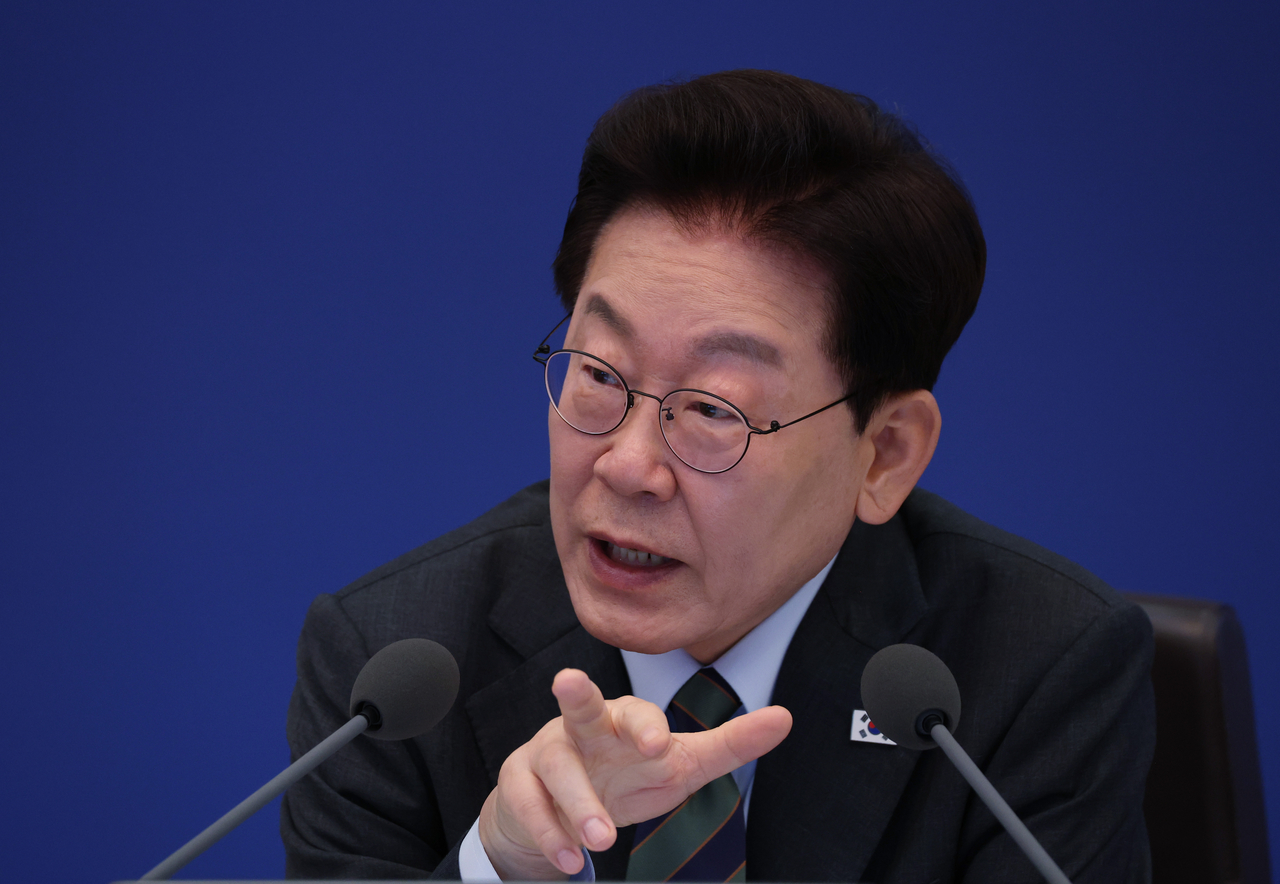
President Lee Jae Myung on Thursday reaffirmed his administration's tough stance against illegal fishing by Chinese vessels in South Korean waters.
Lee declared that there would be no exceptions to law enforcement, as authorities imposed record-high financial bonds on several seized boats.
“In the Republic of Korea, the law is the law. No exceptions, under any circumstances,” Lee wrote on X, sharing a news report on Chinese fishing vessels facing the maximum bond of 1.5 billion won ($1.13 million) each.
Lee accompanied the post with hashtags calling for "a society without rule-breaking or privilege" and "no exceptions in penalizing lawbreakers."
Lee’s remarks come as South Korea has stepped up enforcement against illegal fishing by Chinese vessels following a fivefold increase in the maximum financial bond imposed on foreign boats caught fishing illegally in Korean waters.
According to the Korea Coast Guard on Thursday, two Chinese fishing boats seized on Sept. 16 near the Northern Limit Line, the de facto maritime border with North Korea, off Baengnyeongdo were each ordered to post bonds of 1.5 billion won.
The Coast Guard also said that two of eight Chinese fishing boats seized near the NLL off Yeonpyeongdo on Aug. 11 were ordered to post bonds of 1.5 billion won and 1 billion won, respectively.
The cases marked the first time authorities had imposed bonds exceeding the previous ceiling of 300 million won since amendments to the Act on the Exercise of Sovereign Rights over Foreigners' Fishing in the Exclusive Economic Zone took effect in May.
The amendments raised the maximum bond fivefold to 1.5 billion won, aiming to make illegal fishing financially costly enough to deter repeat offenses.
A bond is a financial guarantee that allows detained vessels and their crews to be released before legal proceedings are completed. The bond is paid back after proceedings close, including the payment of any fines. If the fines are not paid, the bond is forfeited.
Under the United Nations Convention on the Law of the Sea, fishing vessels and crews detained for fisheries violations in a country's exclusive economic zone must be promptly released once a reasonable bond or other security is posted. The release does not mean the violation goes unpunished, as legal proceedings can continue and fines may still be imposed.
Lee has also called for tougher financial penalties during a Coast Guard policy briefing in December, questioning whether existing fines were sufficient to discourage the practice. The president suggested raising penalties to a level that would be financially burdensome even if 10 vessels pooled their money to pay, to effectively curb illegal fishing.
dagyumji@heraldcorp.com